
The Shadow AI Economy: Enterprise AI Is Growing Faster Than Enterprises Can Control It
The most interesting enterprise AI market may be the one companies did not deliberately create.
Employees are using personal ChatGPT and Claude accounts, Gemini, coding copilots, browser extensions and increasingly AI agents to perform real work – often before procurement, IT or security knows they exist. This is shadow AI. But calling it simply a cybersecurity problem misses the more important point: shadow AI is what happens when the speed of individual technology adoption dramatically exceeds the speed at which enterprises can buy and govern technology.
Consider the asymmetry. An employee can discover an AI product and begin using it within minutes. Enterprise procurement works on an entirely different clock. Cresse Insights estimates that an enterprise AI purchase now takes 7.2 months on average, 40% longer than an equivalent software purchase. The typical buying committee involves 11.3 stakeholders, 72% of enterprises require a proof-of-concept, and security and compliance reviews alone add roughly six weeks.
That gap – minutes versus months – is the economic engine behind shadow AI.
It also reverses the traditional enterprise-software adoption funnel. Historically, software moved procurement → deployment → employee adoption. AI increasingly moves employee adoption → workflow dependence → organizational discovery → enterprise contract.
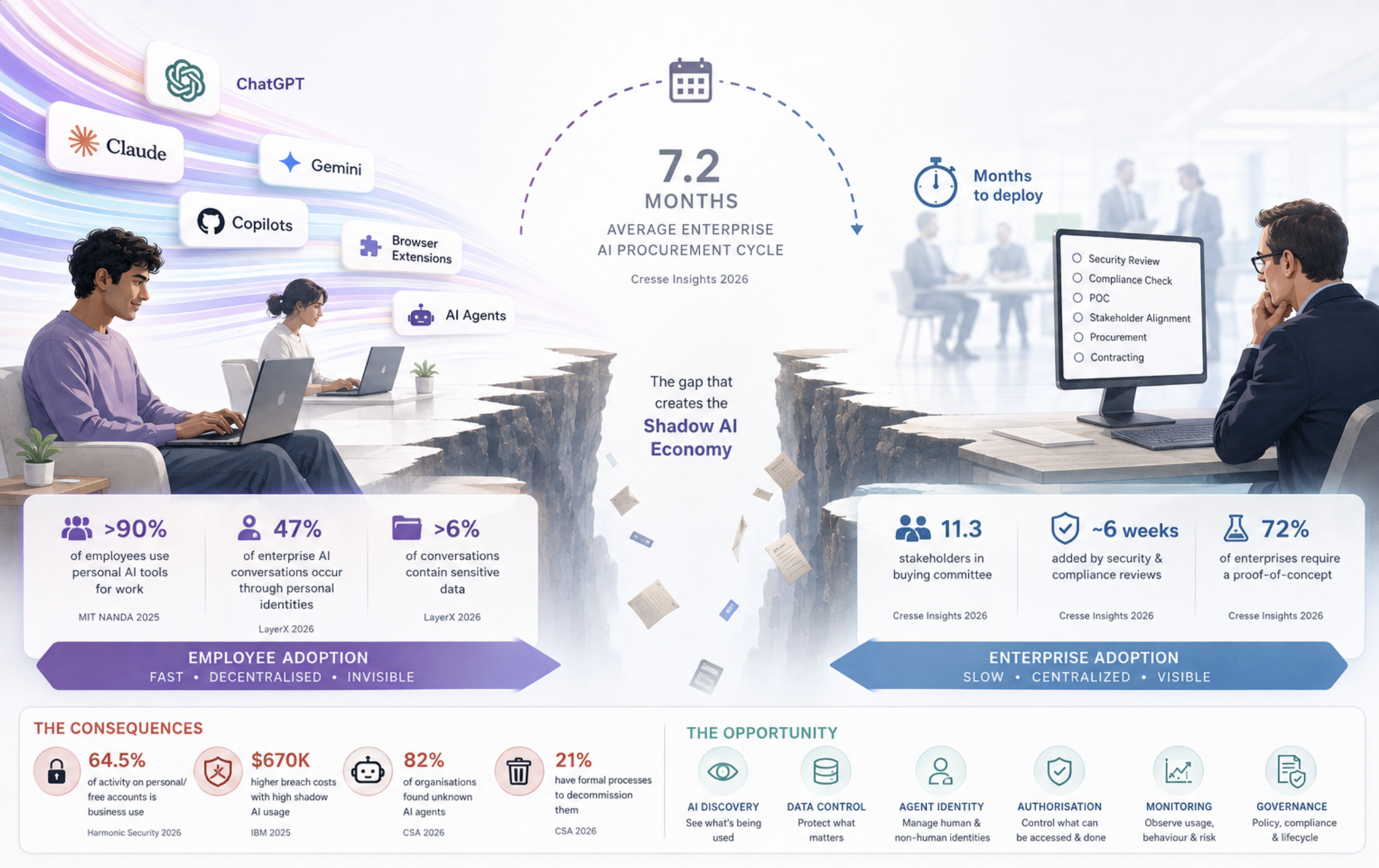
MIT NANDA's GenAI Divide research captured this inversion strikingly: only 40% of surveyed companies said they had purchased an official LLM subscription, while workers at more than 90% reported regularly using personal AI tools for work. Employees were often getting value from flexible consumer tools while formal enterprise initiatives remained stuck in pilots.
That makes shadow AI more than a governance headache. It is becoming a go-to-market model.
Estimates show that 27% of enterprise AI application spend already comes through product-led growth, versus roughly 7% in traditional software. Once shadow usage paid for personally by employees is included, the share could approach 40%. Products such as Cursor and n8n have demonstrated the pattern: individuals adopt first, prove value through actual work, and enterprise contracts follow later.
In effect, AI startups can penetrate enterprises before they sell to them.
The catch is that AI becomes more useful precisely when employees give it more context: source code, customer information, contracts, strategy documents and internal data. Apparently, 47% of enterprise AI conversations occur through personal identities, while more than 6% contain sensitive data. Findings show that 64.5% of activity on personal/free AI accounts was actually business use.
The financial consequences are beginning to appear. IBM's 2025 Cost of a Data Breach research found that organisations with high shadow-AI usage experienced $670,000 higher breach costs on average, while only 37% had policies to manage or detect shadow AI.
And the problem is already evolving beyond chatbots. AI agents can access files, APIs, databases and SaaS applications and act rather than merely answer questions. A 2026 Cloud Security Alliance survey found 82% of organisations had discovered previously unknown AI agents, while only 21% had formal processes for decommissioning them.
The question therefore shifts from “Which AI tools are employees using?” to “Which human and non-human identities are operating inside the enterprise, what can they access, and what are they allowed to do?”
That is where the investment opportunity lies: AI discovery, data control, agent identity, authorisation, monitoring and governance. Regulation reinforces the need – the EU AI Act entered broad application in August 2026, even though certain high-risk requirements remain phased into 2027–28.
Shadow AI is therefore not merely unauthorised ChatGPT usage. It is evidence of a larger transition: enterprise technology adoption is moving from institution-led to user-led – and increasingly agent-led.
The companies that matter most may be those that build the control layer after that transition becomes irreversible.