
The Scarcity Has Moved
Every era is remembered for the problem it made easier to solve.
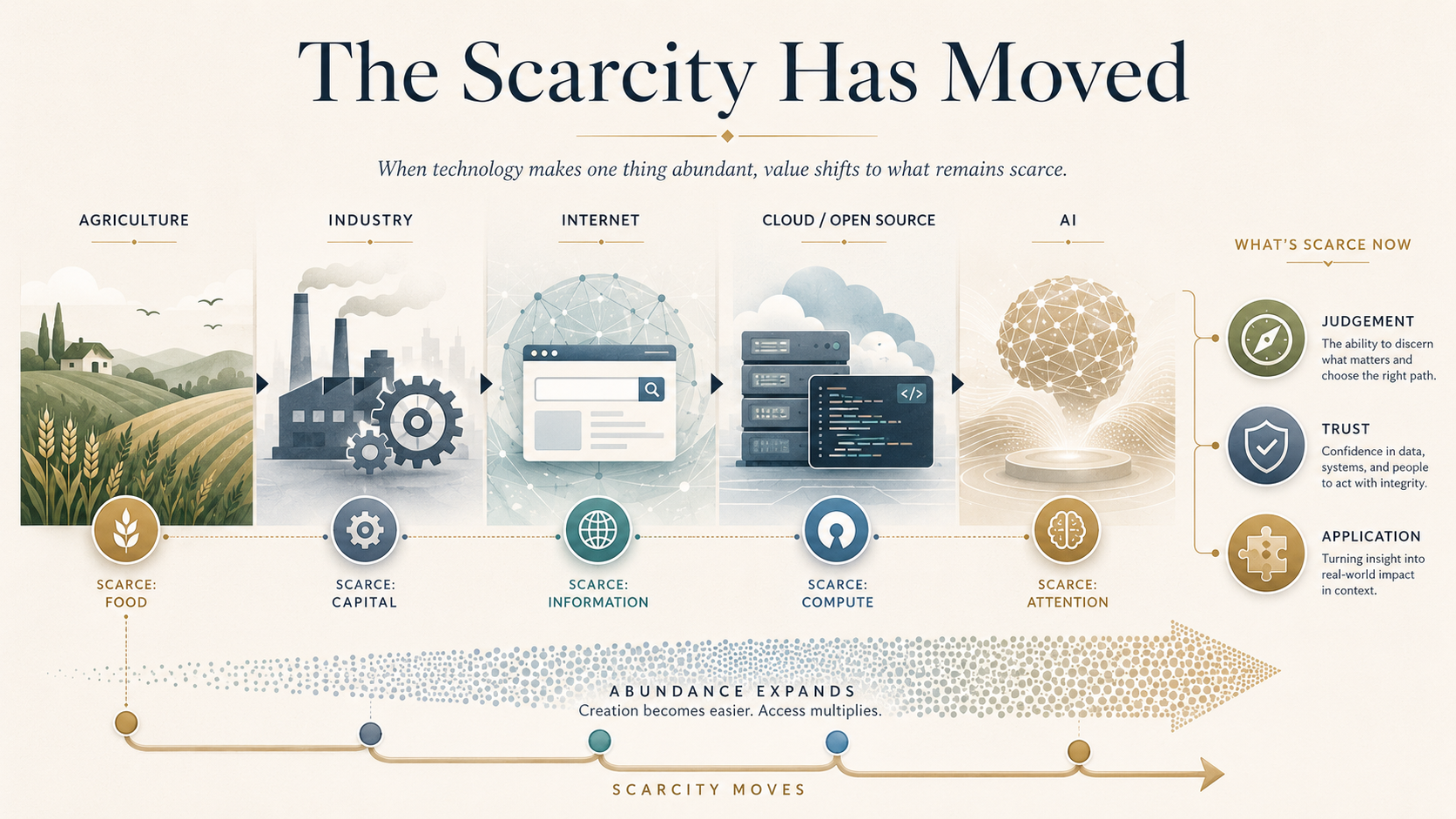
Agriculture expanded the supply of food. Industrialisation made goods cheaper. The internet transformed access to information. Cloud computing lowered the cost of infrastructure. Open source made software tools available to almost anyone. Generative AI is now doing something similar for creation, analysis and technical capability.
These shifts appear to be stories about abundance. But technological revolutions are also stories about scarcity. They do not eliminate it. They move it.
When an innovation weakens one constraint, another becomes more important. The capability that was once difficult becomes accessible, then less differentiating. Value begins to migrate towards whatever now limits the system.
The pattern is simple: a constraint weakens, a capability spreads, the old advantage starts to commoditise and a new bottleneck emerges. The greatest opportunities often lie not in what has just become abundant, but in recognising what remains scarce around it.
Consider the printing press. Before movable type, reproducing a book was slow, expensive and specialised. Once books became easier to produce, ideas travelled further and access to knowledge widened.
As information expanded, readers needed better ways to decide what was credible and worth their attention. Editors, publishers and universities grew in importance because abundance created a new problem: how to navigate it.
The internet repeated the pattern at scale. It made information universally accessible, but shifted the bottleneck from access to discovery. Once almost anything could be found online, the challenge was deciding what to look for and what to trust.
Search engines, social platforms and media brands became valuable because they helped organise abundance. They owned the pathways through which people discovered information.
Cloud computing and open source moved scarcity again. Building software once required capital and technical resources. These tools reduced those barriers, allowing products to be launched faster and with less capital.
As software became easier to build, building software became less of an advantage by itself. Differentiation moved towards customer understanding, distribution, workflow integration and the ability to become difficult to replace.
Technology did not remove competition. It moved competition to another layer.
Writing code, generating content, analysing data and designing products are becoming faster and cheaper. Tasks that once required specialised expertise or large teams can be handled by smaller teams using available tools.
This does not mean expertise no longer matters, or that every output will be good. It means the cost of producing something plausible is falling.
Creation is becoming abundant.
As that happens, the ability to create will matter less as an advantage. A company will not have a durable moat simply because it can generate content, write code or add AI to its product. Competitors will increasingly have access to the same models and tools.
The question will shift from “Can this be built?” to “Should this be built, can it be trusted and can it be applied effectively?”
The first is selection. When ideas and solutions multiply, choosing what is worth pursuing becomes more important. AI can generate hundreds of options, but abundance does not remove the need for judgement. It increases it.
The second is verification. When polished output becomes easy to produce, polish becomes a weaker signal of quality. In a world of infinite content, trust becomes a filter. Evidence, reputation and accountability become more valuable because appearance can be generated so easily.
The third is application. AI models are trained on broad information, but businesses compete in specific contexts. They succeed through customer relationships, operational experience, proprietary data, regulatory knowledge and insights accumulated over time.
For founders, this changes the nature of competitive advantage. As AI tools become available, “using AI” will become less meaningful. The question is what the technology has made cheaper and which constraint has become more important.
The strongest businesses will understand how AI changes the structure of value in their industry and build around the new bottleneck.
Artificial intelligence will continue to make creation cheaper, faster and more accessible. But abundance does not remove scarcity. It reveals the next constraint.
The defining opportunity may therefore lie not in asking what AI can create, but in building around what becomes scarce next: the ability to select well, verify reliably and apply intelligently.