
The Company of One (Plus Agents)
Something has shifted quietly but irreversibly in how businesses are being built. It is not just a productivity improvement, it is a structural rewrite of what a company even needs to exist - and most people have not caught up to that yet.
For decades, building a company meant building a team. You needed people for every function: someone to run finance, someone to handle marketing, someone to manage sales, someone to write the code, someone to keep the operations running. The company was, in many ways, just a well-organised collection of human effort. That model is now being dismantled, function by function, faster than most traditional businesses would like to admit.
Agentic AI - AI that does not just respond to questions but executes tasks, makes decisions, and coordinates workflows autonomously - is not the next version of a productivity tool. It is the infrastructure layer that makes the two-person company possible.
Vinod Dham, the Father of the Pentium chip, has spoken about this moment as something he was waiting to happen - not wondering if it would, but watching the conditions accumulate until it became inevitable. He was right to wait. In early 2024, Sam Altman told Reddit co-founder Alexis Ohanian that he and other tech CEOs had a betting pool for when the first one-person billion-dollar company would emerge - calling it something that would have been unimaginable without AI and that now simply would happen. That moment has arrived. A founder in Los Angeles recently built a telehealth company to $401 million in first-year revenue with two employees and no outside capital, using AI across every function that would have otherwise required a team. The first cars were unreliable too. They still ended the horse.
The point is not the specific company. The point is that the architecture is proven.
Every Entry-Level Function Is Now Automatable
The first wave of AI displaced repetitive, rule-based tasks - data entry, invoice processing, basic queries. That was automation. What agents bring is fundamentally different: the ability to reason across incomplete information, take sequential actions, and work without a human in the loop.
The entire base layer of an organisation - entry-level roles handling execution, follow-ups, reporting, first-pass analysis, scheduling, content production, pre-sales outreach, and research - can now be run by agents operating around the clock at a fraction of the cost. Not augmented. Replaced. The economics are not close.
Pre-sales? An agent researches prospects, qualifies leads, personalises outreach, and books meetings. Marketing? An agent creates content, schedules distribution, tracks engagement, and optimises based on what converts. Customer support? An agent handles Tier 1 and most of Tier 2 without a single ticket ever reaching a human. Growth strategy? An agent runs competitive analysis, surfaces trends, models scenarios, and recommends where to focus next.
What used to require twenty people now requires two: one to define the direction, one to make sure the agents are pointed the right way.
The C-Suite Is Now a Configuration, Not a Headcount
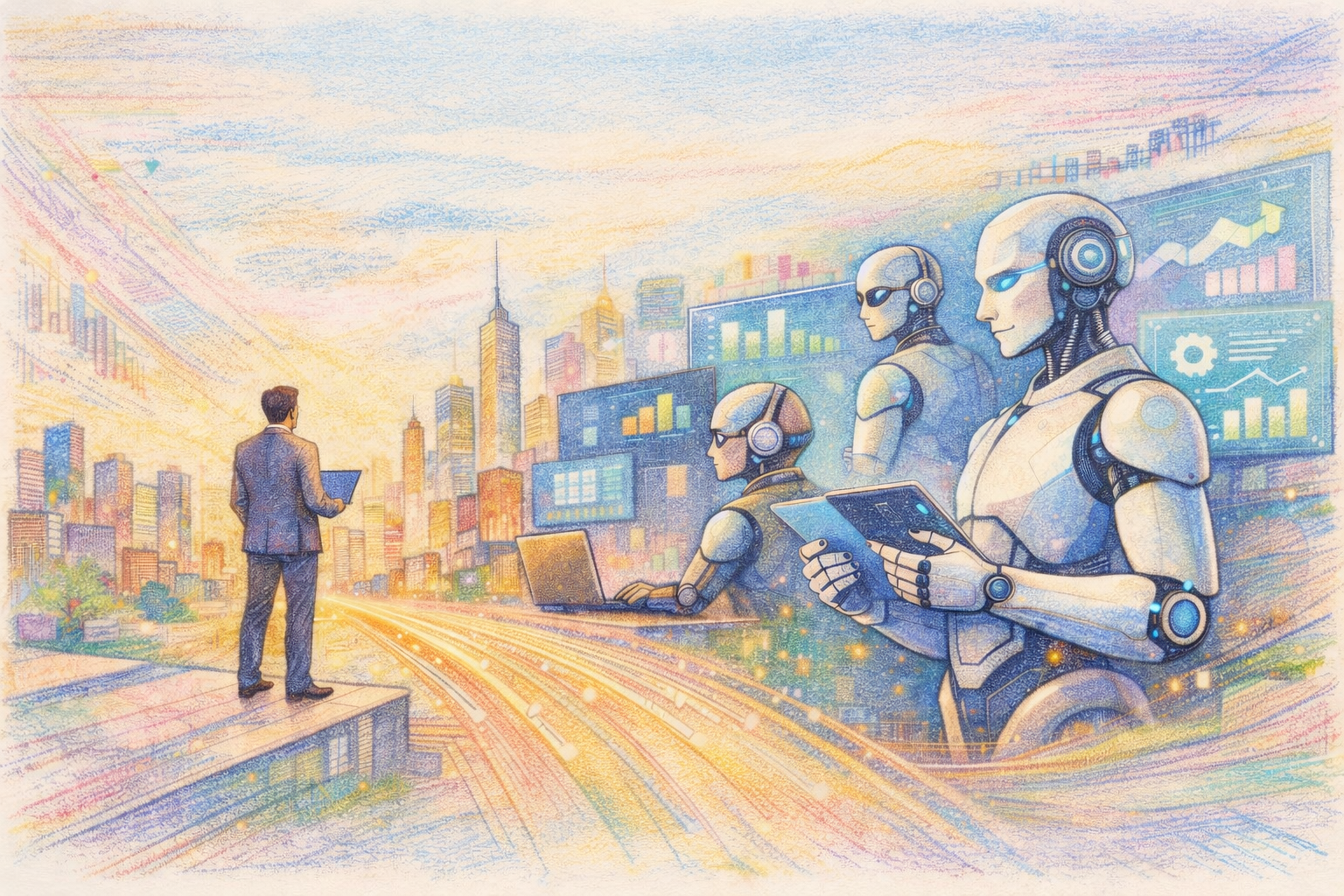
This is the part that sounds like science fiction but is increasingly operational. AI agents today are capable of functioning as the strategic operating layer of a business. A CFO agent that monitors burn, models scenarios, flags anomalies, and prepares board-ready reporting. A CMO agent that owns the content calendar, runs growth experiments, interprets performance data, and adjusts spend in near real time. A CTO agent that manages the product roadmap, reviews code, tracks technical debt, and coordinates delivery.
The founder's role shifts: instead of managing people who execute, you are managing agents that execute and reviewing the output of the ones that strategise. Strategy becomes the input you define. Execution becomes the output agents produce.
This is not about replacing judgment. It is about recognising that a large portion of what C-suite executives actually spend their time on - gathering information, formatting outputs, running reviews, and tracking timelines does not require human judgment at all. Agents handle the operational weight. The human holds the vision and makes the calls that actually require one.
New Businesses Are Being Founded on This Model
Founders are not waiting for permission to build this way. Across the US, a new category of company is emerging - lean on headcount, heavy on agents, and generating real ARR. These are not side projects. These are investor-backed businesses competing in real markets, built by founders who figured out how to deploy agents across every function that traditionally required a team.
The interesting thing is that these founders are not necessarily the most technically sophisticated people in the room. They are the ones who moved their mental model first - from "what do I need to hire for" to "what do I need to configure." That shift in framing is doing more work than the technology itself.
The technology is available to everyone. The clarity about how to use it is not. That gap is where the early advantage lives right now.
The Real Opportunity Is in Building the Infrastructure
If agentic AI is the new operating layer of the modern company, then the most valuable businesses to build right now are the ones helping other businesses make that transition.
AI companies solving for workflow deployment - helping founders configure agents, connect tools, automate business processes, and maintain agent-driven systems - are going to be in enormous demand. Not because it is conceptually interesting, but because there is a growing population of founders who understand what is possible and need a faster, cleaner path to getting there.
This is not the AI picks-and-shovels story of selling GPUs. It is the operational layer story: who builds the system that coordinates what agents do, checks that they are doing it right, and gives founders the confidence to run a real business on infrastructure they did not write themselves? That category is underfunded relative to what it will become. The companies building there quietly today are the ones to watch.
The Shift Has Already Happened. The Mainstream Is Just Late.
The transition from AI-as-tool to AI-as-workforce is not coming. It has arrived. The companies at the frontier are already operating on it. The gap between those businesses and traditionally-built ones is compounding every quarter.
What used to be a talent acquisition problem is now an agent configuration problem. What used to be an organisational design problem is now a systems design problem. What used to be a hiring problem is now a clarity problem: do you know what you want your business to do well enough to describe it to an agent?
Vinod Dham was waiting for this moment. Sam Altman was betting on it. And it is playing out faster than either expected. The one-person, two-person company is not a thought experiment. It is a starting point.
The question is no longer whether agentic AI will replace business functions. That is already settled. The question is whether you will be the one holding the agents - or the one being replaced by them.
– Kushal Bhavsar, Equanimity Investments